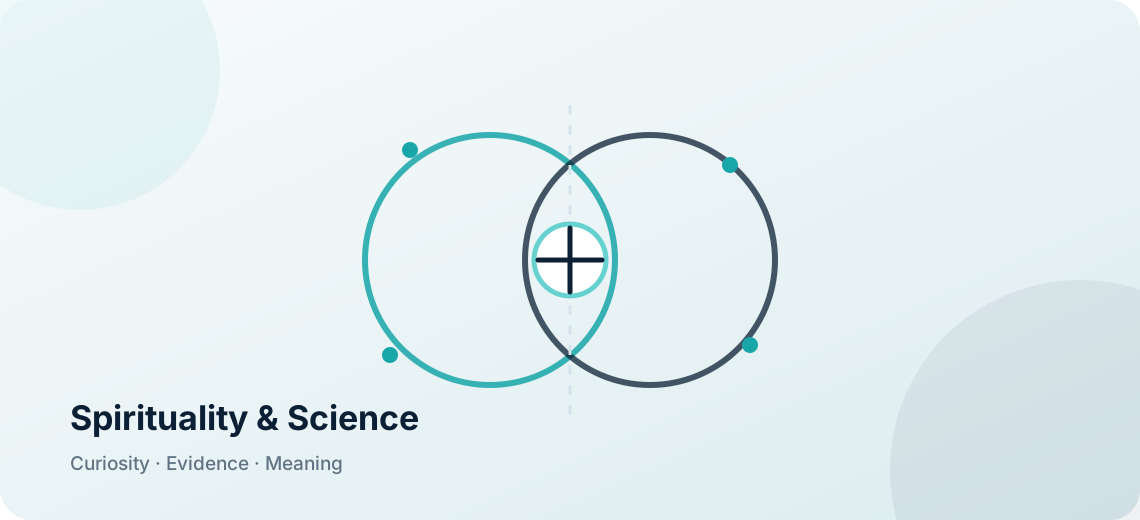
Two different kinds of questions
Science asks what can be observed, measured and tested. Spiritual traditions often ask how experience should be understood, what gives life meaning and how attention, compassion or identity can be cultivated.
Conflict appears when either side claims authority outside its method: when spiritual conviction is presented as laboratory evidence, or when scientific measurement is treated as a complete answer to every question of meaning.
Meditation as a useful meeting point
Meditation illustrates a productive boundary. A tradition may describe it in spiritual language, while researchers can study attention, stress, behaviour and brain activity. The scientific study does not validate every metaphysical interpretation, and the spiritual practice is not exhausted by a scan of the brain.
Both perspectives can contribute when their claims remain clearly labelled.
The importance of epistemic humility
Human perception is vulnerable to expectation, memory distortion and confirmation bias. Scientific methods were built partly to reduce those errors. Yet science also progresses by admitting uncertainty, revising models and investigating observations that do not fit comfortably.
Epistemic humility means being open without becoming credulous and sceptical without becoming dismissive.
Technology does not settle philosophical questions
Wearables, EEG, HRV and imaging can provide useful signals. AI can identify patterns and help organise literature. None of these tools automatically determines whether a subjective experience has spiritual meaning.
Meaning is interpreted by people and communities. Measurement can inform that interpretation, but it cannot replace it.
A responsible culture of exploration
A mature dialogue protects vulnerable people, avoids medical promises, welcomes critical review and distinguishes personal testimony from general evidence. It also recognises that awe, ethics and inner practice are legitimate parts of human life even when they are not laboratory variables.
The most interesting space between spirituality and science is therefore not a shortcut to certainty. It is a disciplined practice of asking better questions.
Putting the idea into practice
The greatest value comes from turning an idea into a small, testable process. Define the goal and baseline first, change only what can be observed, and record the result. In technical work this means measurements, logs and repeatable tests; in personal practices it means a clear intention, a time frame, and separating subjective impressions from measurable change.
It is equally important to distinguish possibility from evidence. An interesting hypothesis can justify exploration, but it is not yet an established fact. PICALLW therefore favours transparency where technology, human experience and less-established approaches meet: what is well supported by research, what is practical experience, and what should still be treated as experimental.